<?xml version="1.0" encoding="utf-8"?><feed xmlns="http://www.w3.org/2005/Atom" ><generator uri="https://jekyllrb.com/" version="3.10.0">Jekyll</generator><link href="https://dtabaker.github.io/feed.xml" rel="self" type="application/atom+xml" /><link href="https://dtabaker.github.io/" rel="alternate" type="text/html" /><updated>2026-10-18T00:06:43+00:00</updated><id>https://dtabaker.github.io/feed.xml</id><title type="html">Dillon Baker — My PhD Journey</title><subtitle>Field notes on computational chemistry, coding, teaching, and PhD life at the University of Memphis.</subtitle><author><name>Dillon Baker</name></author><entry><title type="html">Orbital Observatory: How Orbitals Mix</title><link href="https://dtabaker.github.io/hybrid-orbitals/" rel="alternate" type="text/html" title="Orbital Observatory: How Orbitals Mix" /><published>2026-10-17T17:00:00+00:00</published><updated>2026-10-17T17:00:00+00:00</updated><id>https://dtabaker.github.io/hybrid-orbital-lab</id><content type="html" xml:base="https://dtabaker.github.io/hybrid-orbitals/"><![CDATA[<p>What changes when we mix an s orbital with a p orbital? The answer depends on what we add. Adding <strong>wavefunctions</strong> allows constructive and destructive interference. Adding their <strong>probability densities</strong> leaves out that interference and gives a different distribution.</p>

<p>The <strong>Hybrid Orbital Lab</strong> makes that distinction interactive. Move the s-character slider, reverse the relative sign, and compare three linked views of the same mathematical ingredients. Then explore how one hybrid fits into a complete sp, sp², or sp³ set. A further section brings d orbitals into the basis through square-planar dsp², trigonal-bipyramidal sp³d, and octahedral sp³d² constructions, with linked sliders to vary one orbital’s s, p, and d character.</p>

<p>This continues the <a href="/2026/09/07/orbital-observatory.html">Orbital Observatory</a> series, alongside <a href="/wavefunction-to-orbital/">From Wavefunction to Orbital</a> and <a href="/orbital-scale/">A Sense of Scale</a>.</p>

<p><a href="/assets/hybrid-orbital-lab.html" target="_blank" rel="noopener">Open the Hybrid Orbital Lab in a full window ↗</a></p>

<iframe id="hybrid-orbital-embed" src="/assets/hybrid-orbital-lab.html" title="Hybrid Orbital Lab: s/p character, interference, and complete s/p/d hybrid constructions" width="100%" height="1600" style="display:block; width:100%; border:1px solid #d8dfdf; border-radius:10px;" loading="lazy">
</iframe>

<p>Scroll within the model to reach the complete s/p sets, the section including d orbitals, and the model notes. The full-window link gives the comparisons more room, particularly on a phone.</p>

<h2 id="character-is-a-squared-coefficient">Character is a squared coefficient</h2>

<p>For the normalized, orthogonal 2s and 2p basis functions in the slider section, one hybrid is</p>

<p><strong>h = √f φ<sub>s</sub> + σ√(1 − f) φ<sub>p</sub>.</strong></p>

<p>Here f is the s-character fraction, σ is +1 or −1, and φ<sub>p</sub> is the selected 2p function. The coefficient of the s function is √f, so <strong>25% s character means an s coefficient of 0.5</strong>, not 0.25. These percentages describe components in the chosen orbital basis, not separate pieces of an electron occupying different lobes.</p>

<p>Squaring the combined wavefunction gives the hybrid probability density. For these real functions,</p>

<p><strong>ρ = f&#124;φ<sub>s</sub>&#124;² + (1 − f)&#124;φ<sub>p</sub>&#124;² + 2σ√[f(1 − f)]φ<sub>s</sub>φ<sub>p</sub>.</strong></p>

<p>The last term is the interference term. It can increase or decrease the density at a point; the total density remains nonnegative. The density-only mixture omits this cross term. It represents an incoherent mixture of the two basis states, rather than the same pure hybrid state drawn another way.</p>

<h2 id="try-these-comparisons">Try these comparisons</h2>

<ol>
  <li><strong>Reverse the relative sign.</strong> Start at 50% s character. Changing the p contribution from + to − reflects the hybrid density along the selected p axis. The density-only mixture stays unchanged. Reversing the overall sign of the entire wavefunction, by contrast, would leave its density unchanged.</li>
  <li><strong>Inspect a point.</strong> Move the shared probe across a slice and compare hybrid density, mixture density, and their difference. At a node of either component, the cross term vanishes.</li>
  <li><strong>Visit both endpoints.</strong> At pure s or pure p, one coefficient is zero. There is no interference between s and p, so the two density views agree everywhere.</li>
  <li><strong>Build the whole set.</strong> The sp construction contains two hybrids and two unused p orbitals; sp² has three hybrids and one unused p orbital; sp³ has four hybrids. Select individual orbitals when their surfaces overlap.</li>
</ol>

<p>The equivalent sp, sp², and sp³ hybrids have 50%, 33⅓%, and 25% s character, respectively. Their direction vectors form the familiar 180°, 120°, and approximately 109.47° angles. These are ideal orbital constructions, not predictions of every molecular bond angle. A single orbital with 33⅓% s character does not by itself specify a trigonal arrangement.</p>

<p>The complete four-orbital bases remain orthonormal. Summing all four orbital densities, including unused p functions, gives the same unweighted sum as the original 2s/2p basis. That identity does not specify a molecule’s occupied orbitals or electron density.</p>

<h2 id="bringing-d-orbitals-into-the-basis">Bringing d orbitals into the basis</h2>

<p>The d-containing section uses nine normalized hydrogenic functions: <strong>3s, three 3p functions, and five real 3d functions</strong>, all at Z = 1. Choose a construction, inspect one orbital at a time, or overlay the set. Three side-by-side panels show its <strong>wavefunction, hybrid density, and density-only mixture</strong>, linked to the character sliders. They share a camera, spatial scale, and density cutoff. The wavefunction and hybrid-density panels share exactly the same boundary geometry. Adding the unused orbitals to an overlay shows separate functions, not their summed wavefunction, summed density, or a molecular electron density.</p>

<table>
  <thead>
    <tr>
      <th>Construction</th>
      <th>Character of each hybrid: s / p / d</th>
      <th>Unused functions in the nine-function basis</th>
    </tr>
  </thead>
  <tbody>
    <tr>
      <td>dsp²: four square-planar hybrids</td>
      <td>25% / 50% / 25%</td>
      <td>Five: p<sub>z</sub>, d<sub>xy</sub>, d<sub>xz</sub>, d<sub>yz</sub>, d<sub>z²</sub></td>
    </tr>
    <tr>
      <td>sp³d: three equatorial and two axial hybrids</td>
      <td>Equatorial: 33⅓% / 66⅔% / 0%<br />Axial: 0% / 50% / 50%</td>
      <td>Four: d<sub>xy</sub>, d<sub>xz</sub>, d<sub>yz</sub>, d<sub>x²−y²</sub></td>
    </tr>
    <tr>
      <td>sp³d²: six octahedral hybrids</td>
      <td>16⅔% / 50% / 33⅓%</td>
      <td>Three: d<sub>xy</sub>, d<sub>xz</sub>, d<sub>yz</sub></td>
    </tr>
  </tbody>
</table>

<p>The sp³d set is particularly instructive: <strong>its five orbitals are not equivalent</strong>. In the orthonormal convention used here, the three equatorial functions are sp² combinations, while the axial pair mixes p<sub>z</sub> with d<sub>z²</sub>. The set name counts the input functions; it does not mean every member contains every orbital type. The 20% s / 60% p / 20% d composition is the average across all five, not the composition of each one. The coefficient convention follows <a href="https://wannier90.readthedocs.io/en/latest/user_guide/wannier90/projections/#hybrids">Wannier90’s explicit hybrid table</a>; the display uses hydrogenic n = 3 radial functions rather than calculating Wannier functions.</p>

<p>The three linked character sliders let you change a selected orbital continuously while keeping the total at 100%. Moving one proportionally rebalances the other two; if both are zero, they share the remainder equally. <strong>Restore selected orbital</strong> returns to the exact preset. The sliders edit one orbital, so an overlay must first be changed to an individual selection.</p>

<p>During a scan, the selected reference supplies fixed normalized s, p, and d components, including their internal signs. Their weights are the square roots of the character fractions. If a component is absent from the reference, the editor explicitly supplies positive 3s, 3p<sub>z</sub>, or 3d<sub>z²</sub>, as appropriate. A custom orbital remains normalized, but substituting it into the reference set would generally break orthogonality. The original complete sets remain available unchanged.</p>

<p>Calling those normalized components S, P, and D, the displayed hybrid is h = √f<sub>s</sub>S + √f<sub>p</sub>P + √f<sub>d</sub>D, with f<sub>s</sub> + f<sub>p</sub> + f<sub>d</sub> = 1. The density-only mixture is</p>

<p><strong>ρ<sub>mix</sub> = f<sub>s</sub>&#124;S&#124;² + f<sub>p</sub>&#124;P&#124;² + f<sub>d</sub>&#124;D&#124;².</strong></p>

<p>It removes interference <strong>between the s, p, and d components</strong>, while keeping the chosen shape within each group. In particular, P or D may itself combine several p or d basis functions whose internal interference remains. The difference between the hybrid density and this mixture consists of the three cross terms: 2√(f<sub>s</sub>f<sub>p</sub>)SP + 2√(f<sub>s</sub>f<sub>d</sub>)SD + 2√(f<sub>p</sub>f<sub>d</sub>)PD. Both densities are nonnegative and integrate to one for a normalized selected orbital, but they describe different states. Try moving a character slider to 100%: the two density panels agree everywhere, including for an oriented p or d combination.</p>

<p>The <strong>linked cross-sections and shared probe</strong> let students check this distinction at the same spatial point. Choose the xy, xz, or yz plane through the nucleus, then point to a slice, tap it, use its arrow keys, or enter coordinates. Each slice spans −24 to +24a₀ along both displayed axes. Changing the plane resets the probe to the nucleus; changing character keeps its coordinates. The readout shows signed amplitude, both densities, their difference, and the individual s–p, s–d, and p–d interference terms. Select one orbital to use the slices and probe; an overlay has no single combined wavefunction to sample.</p>

<p>These are values of the analytic functions on a plane, <strong>not projections or integrals through the orbital</strong>. The 3D cutoff, cutaway, and camera do not change them. The two density slices share a fixed square-root color scale that saturates at 0.0004a₀⁻³; the signed-amplitude scale saturates at ±0.02a₀<sup>−3/2</sup>. Saturation affects colors only: the probe reports the underlying values without clipping. A slice lying in an angular nodal plane can be blank even though the orbital is nonzero elsewhere—try another plane. Density and interference readouts have units a₀⁻³; signed amplitude has units a₀<sup>−3/2</sup>.</p>

<p>Character remains a sum of squared coefficients. For example, an octahedral hybrid can contain both d<sub>z²</sub> and d<sub>x²−y²</sub>; their squared coefficients add to its total d character. For each reference preset, including all unused functions completes an orthonormal nine-function basis, and its unweighted sum of orbital densities equals that of the original nine functions. This does not assign nine electrons to the basis.</p>

<p>These constructions illustrate symmetry and interference. <strong>A molecular shape does not establish substantial d hybridization.</strong> The historical sp³d and sp³d² descriptions of main-group molecules such as PF₅ and SF₆ should not be taken as their bonding mechanism; ab initio studies support much smaller d-orbital contributions and descriptions involving polar or multicenter bonding. See <a href="https://doi.org/10.1021/ic011003v">Noury, Silvi, and Gillespie’s study of hypervalent bonding</a>. In transition-metal compounds, the metal–ligand interactions, orbital energies, and occupations must be considered together, for example in <a href="https://doi.org/10.1103/PhysRevB.85.165113">molecular-orbital and ligand-field treatments</a>.</p>

<p>The n = 3 basis also retains radial structure: 3s has two radial nodes, 3p has one at r = 6a₀, and 3d has none. Direction labels describe the symmetry of the coefficient construction; radial phase changes mean they need not identify the largest lobe at every radius. This section has its own scale bar and lower density cutoffs. It does not model a transition metal’s 3d/4s/4p shell ordering, ligand orbitals, or spin state.</p>

<h2 id="what-this-model-represents">What this model represents</h2>

<p>The s/p slider and first complete-set section use normalized hydrogenic <strong>2s, 2pₓ, 2pᵧ, and 2p<sub>z</sub> at Z = 1</strong>; the d-containing section uses the separate n = 3 basis described above. Both use a fixed-nucleus, nonrelativistic one-electron model. Functions within a given n shell are degenerate in this model, which does not establish equal orbital energies in a many-electron atom or molecule. The slider scans coefficients; it is not a movie of an atom forming a bond, an excitation, or a chemical reaction. The display illustrates the mathematics of hybridization and does not calculate carbon bonding orbitals, molecular energies, or bond strengths.</p>

<p>The 2s basis function has a radial node at 2a₀, where a₀ is the Bohr radius. A hybrid’s nodes change through interference and need not retain that spherical node. This radial structure is one reason these surfaces can look different from simplified textbook hybrid lobes. A cutaway and the analytic slices in the s/p comparison help reveal the interior structure.</p>

<p>Colors in the wavefunction view indicate positive and negative amplitude, not electrical charge. The wavefunction and hybrid-density panels use <strong>the same boundary geometry</strong>, colored differently. Each three-panel comparison shares one physical scale internally. The n = 3 comparison has its own 5a₀ scale bars and lower cutoffs, distinct from the n = 2 views.</p>

<p>Surfaces are drawn at a selected fixed probability-density cutoff in a₀⁻³. They do <strong>not</strong> enclose a specified percentage of probability, and they are not hard orbital edges. Small features near a cutoff may be unresolved by the finite mesh. In From Wavefunction to Orbital and A Sense of Scale, each orbital uses its own cutoff chosen for approximately 90% probability. Here, the comparison uses one selected density cutoff without fixing the enclosed probability.</p>

<p>For the underlying mathematics, see <a href="https://books.physics.oregonstate.edu/GMM/hydroform.html">Oregon State University’s hydrogen radial functions and spherical harmonics</a> and <a href="https://www.pci.tu-bs.de/aggericke/PC4e/Kap_II/Hybride/Konstruktion.htm">TU Braunschweig’s normalized hybrid-orbital constructions</a>. The bundled Three.js renderer retains its <a href="/assets/THREE-LICENSE.txt">MIT license</a>.</p>]]></content><author><name>Dillon Baker</name></author><category term="Teaching &amp; outreach" /><summary type="html"><![CDATA[Continuously vary s/p/d orbital character, compare wavefunctions and densities, and explore complete sp, sp², sp³, dsp², sp³d, and sp³d² constructions.]]></summary></entry><entry><title type="html">Orbital Observatory: A Sense of Scale</title><link href="https://dtabaker.github.io/orbital-scale/" rel="alternate" type="text/html" title="Orbital Observatory: A Sense of Scale" /><published>2026-10-14T05:00:00+00:00</published><updated>2026-10-14T05:00:00+00:00</updated><id>https://dtabaker.github.io/orbital-sense-of-scale</id><content type="html" xml:base="https://dtabaker.github.io/orbital-scale/"><![CDATA[<p>Orbital drawings often make every shape about the same size. That helps us compare their angular patterns, but hides their relative spatial extent. <strong>A Sense of Scale</strong> puts the sixteen Orbital Observatory states on one shared ruler, with synchronized rotation and zoom.</p>

<p>This is a companion to <a href="/2026/09/07/orbital-observatory.html">the original Orbital Observatory</a> and <a href="/wavefunction-to-orbital/">From Wavefunction to Orbital</a>. The original viewer emphasizes shape; the wavefunction model connects mathematical factors to a spatial distribution. This page makes physical size the comparison.</p>

<p>For orbital mixing and interference, explore <a href="/hybrid-orbitals/">Orbital Observatory: How Orbitals Mix</a>, with an s/p-character slider and complete sp, sp², and sp³ sets.</p>

<p><a href="/assets/orbitals-to-scale.html" target="_blank" rel="noopener">Open A Sense of Scale in a full window ↗</a></p>

<iframe id="orbital-scale-embed" src="/assets/orbitals-to-scale.html" title="Orbital Observatory: A Sense of Scale, sixteen orbitals with one shared physical ruler" width="100%" height="1600" style="display:block; width:100%; border:1px solid #d8dfdf; border-radius:10px;" loading="lazy">
</iframe>

<noscript><p>The interactive model needs JavaScript and WebGL. The explanation and reference values below remain available without JavaScript.</p></noscript>

<p>Scroll within the model to reach the radial graphs and assumptions. The full-window link gives the comparisons more room, particularly on a phone.</p>

<h2 id="does-increasing-nuclear-charge-really-make-an-orbital-smaller">Does increasing nuclear charge really make an orbital smaller?</h2>

<p><strong>Yes, for a fixed orbital state in this one-electron model.</strong> Nuclear charge Z is the number of protons. Increasing it strengthens the attraction between the nucleus and the same single electron. In the nonrelativistic, fixed-nucleus Coulomb model, every characteristic length contracts in proportion to <strong>1/Z</strong>.</p>

<p>For the same state, He⁺ (Z = 2) therefore has half the characteristic size of H (Z = 1); Li²⁺ (Z = 3) has one-third, and Be³⁺ (Z = 4) has one-quarter. The camera scale stays fixed when you change Z, so the contraction is visible rather than canceled by automatically fitting the orbital to its panel.</p>

<p>The mean electron–nucleus distance is</p>

<p class="orbital-equation"><strong>⟨r⟩ = [3n² − ℓ(ℓ + 1)]a₀ / (2Z).</strong></p>

<p>Here n is the principal quantum number, ℓ is the orbital angular-momentum quantum number, and a₀ is the Bohr radius, approximately 0.529177 Å. For 1s, ⟨r⟩ is 1.5a₀ in H and 0.75a₀ in He⁺. The normalized three-dimensional probability density increases as the distribution contracts: ρ<sub>Z</sub>(<strong>r</strong>) = Z³ρ<sub>1</sub>(Z<strong>r</strong>), keeping its integral equal to one.</p>

<p><strong>He⁺ is not neutral helium.</strong> Neutral many-electron atoms also involve electron repulsion and shielding. Adding a proton and an electron changes more than Z in a one-electron equation. This viewer should not be read as a quantitative sequence of neutral-atom sizes or as an exact rule for all periodic trends.</p>

<h2 id="try-these-comparisons">Try these comparisons</h2>

<ol>
  <li><strong>Keep the ruler fixed.</strong> Start at Z = 1 and compare 1s, 2p, 3d, and 4f. Their mean radii are 1.5, 5, 10.5, and 18a₀. These are expectation values, not the outer edges of the displayed surfaces.</li>
  <li><strong>Change only Z.</strong> Switch from H to He⁺. The surfaces and mean radii contract by one-half. Return to H and notice that the common viewing window is unchanged.</li>
  <li><strong>Change units.</strong> Switch between Bohr radii and ångströms. The labels and ruler convert; the physical orbital sizes do not change.</li>
  <li><strong>Compare angular forms.</strong> Use the orbital selectors, or show all sixteen orbitals. States in the same subshell share the same radial distribution and mean radius, although their angular shapes and farthest surface points can differ. Not every real d or f angular form is simply a rotation of another.</li>
  <li><strong>Read the radial graph.</strong> Its curves show P(r) = r²|R(r)|², the probability per unit radial distance. For these n = ℓ + 1 states, the radial-probability peak is at n²a₀/Z. A graph peak, mean radius, and isodensity boundary answer different questions.</li>
</ol>

<p>Drag any panel to rotate all of them, use the front/top/3D buttons, or use arrow keys on a focused view. Zoom is shared across panels. The radial chart’s horizontal distance axis stays fixed as Z changes, while the labeled probability-density axis rescales.</p>

<h2 id="what-the-surfaces-mean">What the surfaces mean</h2>

<p>The collection contains <strong>1s, three 2p, five 3d, and seven 4f real orbitals</strong>. These states have no radial nodes. They are alternative states of a one-electron system, not sixteen electrons occupying one atom, and they do not include every orbital through n = 4.</p>

<p>Each displayed surface approximates the boundary of an orbital-specific isodensity region containing 90% of that state’s probability, summed over all lobes and both signs. Probability extends outside the region, and there is no hard atomic edge. The chosen density threshold is different for different orbitals. Blue and coral represent wavefunction sign, not opposite charge.</p>

<p>Every panel uses the same orthographic viewing width and physical coordinate system. The small nucleus marker and axes are annotations, not physical-size models of a nucleus. The meshes are finite-resolution approximations; the underlying analytic regions and coordinate conversions have independent numerical checks. These hydrogenic shapes do not provide quantitative sizes for orbitals in neutral many-electron atoms.</p>

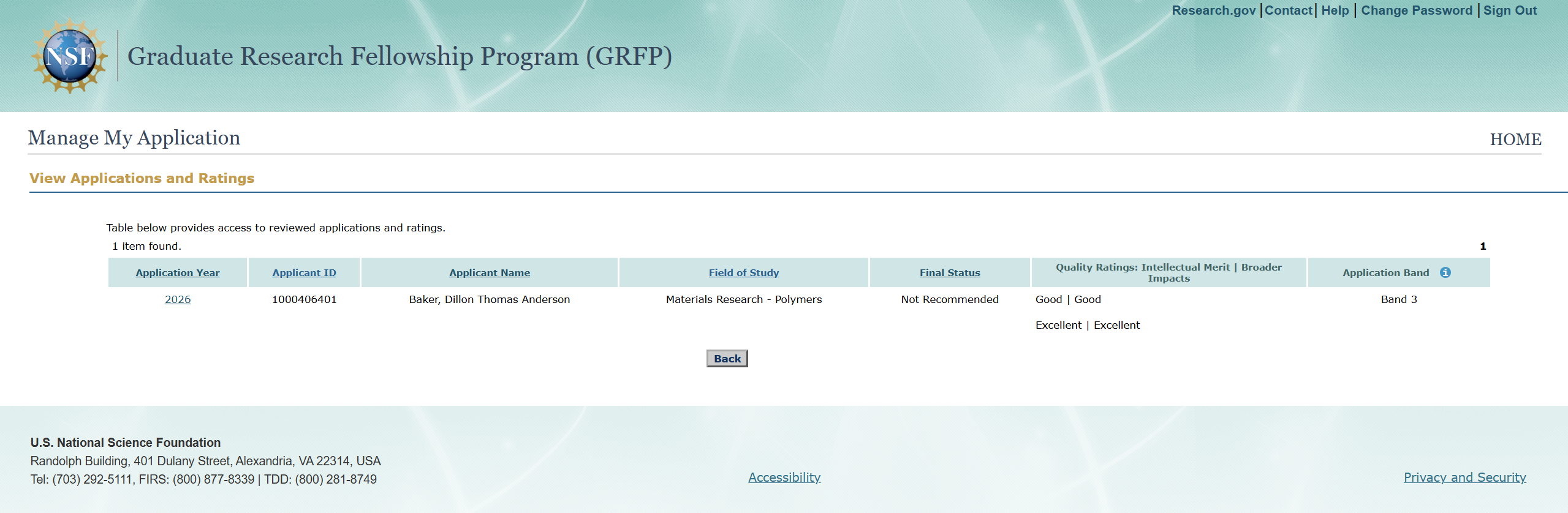
<p>For the mathematical background, see <a href="https://books.physics.oregonstate.edu/GMM/hydroform.html">Oregon State University’s hydrogen radial functions and spherical harmonics</a> and Richard Fitzpatrick’s <a href="https://farside.ph.utexas.edu/teaching/qmech/lectures/node82.html">Hydrogen Atom</a>. The Bohr-radius conversion uses <a href="https://physics.nist.gov/cuu/Constants/Table/allascii.txt">NIST’s physical constants</a>. The bundled Three.js renderer retains its <a href="/assets/THREE-LICENSE.txt">MIT license</a>.</p>]]></content><author><name>Dillon Baker</name></author><category term="Teaching &amp; outreach" /><summary type="html"><![CDATA[Compare sixteen hydrogenic orbitals on one physical scale, explore nuclear-charge contraction, and connect three-dimensional probability surfaces to radial probability distributions.]]></summary></entry><entry><title type="html">A long shot worth taking: my NSF GRFP experience</title><link href="https://dtabaker.github.io/2026/10/13/nsf-grfp-reflections.html" rel="alternate" type="text/html" title="A long shot worth taking: my NSF GRFP experience" /><published>2026-10-13T05:00:00+00:00</published><updated>2026-10-13T05:00:00+00:00</updated><id>https://dtabaker.github.io/2026/10/13/nsf-grfp-reflections</id><content type="html" xml:base="https://dtabaker.github.io/2026/10/13/nsf-grfp-reflections.html"><![CDATA[<p>Around this time last year, I was putting together my application for the <strong>National Science Foundation Graduate Research Fellowship Program (NSF GRFP)</strong>. The reviews were just released, and I received neither the fellowship nor an honorable mention. I knew it was a long shot when I applied, but I’m grateful for the opportunity and for everyone who helped me give it my best effort.</p>

<p>My advisor, <strong>Dr. Yongmei Wang</strong>, has given me so much guidance and support, and I’m thankful to have had her encouragement throughout this process. I’m also grateful to <strong>Dr. Qianyi Cheng</strong> and <strong>Dr. Nathan DeYonker</strong> in the Chemistry Department, and to my former mathematics professor and mentor, <strong>Dr. Bhawesh Mishra</strong>, for their recommendation letters and support. Having people willing to invest their time and put their confidence in me meant a great deal.</p>

<p>Dr. Cheng deserves a special shoutout for saving the day. She noticed that <strong>my portion of the application was due a full week before the recommendation letters</strong>. I’m normally good about deadlines, but I would have missed this one without her diligence. There was plenty of coffee involved in this application, but coffee apparently does not read the deadline instructions for you. Thank you, Dr. Cheng!</p>

<p>The application took many hours of drafting, late nights, and more cups of coffee than I care to count. It also pushed me to step back from the day-to-day details of my research and think carefully about the bigger picture: what I want my project to accomplish, why it matters, and how the work I’m doing now connects to my long-term goals.</p>

<p>That time was not in vain. Working through those questions gave me a clearer sense of direction and concrete goals to work toward during my PhD. I’m carrying that clarity forward, along with a lot of gratitude for the people who helped me get here.</p>

<figure class="project-figure">
  <a href="/assets/nsf-grfp-2026-reviews.png" aria-label="View the NSF GRFP ratings screenshot at full size">
    <img src="/assets/nsf-grfp-2026-reviews.png" alt="My 2026 NSF GRFP application result: Not Recommended, with Intellectual Merit and Broader Impacts ratings of Good | Good and Excellent | Excellent." width="2559" height="838" loading="lazy" />
  </a>
  <figcaption>It’s always reviewer #2… except I’m pretty proud of both of these reviews. Select the image to view the ratings at full size.</figcaption>
</figure>

<p>And yes, I’m proud of my <strong>Good | Good</strong> and <strong>Excellent | Excellent</strong> ratings for Intellectual Merit and Broader Impacts, regardless of the final outcome. There’s encouragement in that feedback, and plenty of motivation to keep going.</p>

<p>Thank you to everyone who supported me through the application. I’m grateful for your time, your guidance, and your belief in me—and I’m looking forward to putting what I learned to work.</p>]]></content><author><name>Dillon Baker</name></author><category term="PhD life" /><summary type="html"><![CDATA[Reflecting on my NSF GRFP application, the mentors who supported me, and the clearer sense of direction I gained for my PhD.]]></summary></entry><entry><title type="html">From wavefunction to orbital: explore the mathematics of shape</title><link href="https://dtabaker.github.io/wavefunction-to-orbital/" rel="alternate" type="text/html" title="From wavefunction to orbital: explore the mathematics of shape" /><published>2026-10-12T22:00:00+00:00</published><updated>2026-10-12T22:00:00+00:00</updated><id>https://dtabaker.github.io/wavefunction-to-orbital</id><content type="html" xml:base="https://dtabaker.github.io/wavefunction-to-orbital/"><![CDATA[<p>How does a wavefunction become the orbital shapes we draw in chemistry? This companion to the <a href="/2026/09/07/orbital-observatory.html">Orbital Observatory</a> connects the mathematics to the picture. Move one shared probe and watch its distance, direction, wavefunction amplitude, and probability density update together.</p>

<p>The model includes all <strong>16 Observatory orbitals</strong>—1s, three 2p, five 3d, and seven 4f—plus <strong>2s, 3s, and 3p_z</strong> to explore radial nodes. These 19 states form a selected teaching set, rather than every orbital through n = 4.</p>

<p>For a direct size comparison, open <a href="/orbital-scale/">Orbital Observatory: A Sense of Scale</a>. It puts the original sixteen orbitals on one common physical ruler and explains why increasing nuclear charge contracts a one-electron orbital.</p>

<p>For orbital mixing and interference, explore <a href="/hybrid-orbitals/">Orbital Observatory: How Orbitals Mix</a>, with an s/p-character slider and complete sp, sp², and sp³ sets.</p>

<p><a href="/assets/wavefunction-to-orbital.html" target="_blank" rel="noopener">Open From Wavefunction to Orbital in a full window ↗</a></p>

<iframe id="wavefunction-orbital-embed" src="/assets/wavefunction-to-orbital.html" title="From Wavefunction to Orbital: four linked views of quantum mathematics" width="100%" height="1500" style="display:block; width:100%; border:1px solid #d8dfdf; border-radius:10px;" loading="lazy">
</iframe>

<noscript><p>The interactive model needs JavaScript, and its 3D views require WebGL. The explanation below remains available without JavaScript.</p></noscript>

<p>The model scrolls within the frame. For more room, especially on a phone, use the full-window link above.</p>

<h2 id="follow-a-point-through-four-views">Follow a point through four views</h2>

<ol>
  <li><strong>Distance:</strong> the radial function R(r) shows how amplitude changes with distance from the nucleus. The second graph shows the shell probability density P(r) = r²|R(r)|², including the radial volume weighting.</li>
  <li><strong>Direction:</strong> the angular function Y(θ, φ) colors a unit sphere. Rotate it or change the angles to explore signs, orientations, and angular nodes.</li>
  <li><strong>Product:</strong> the cross-section shows ψ = RY or the probability density |ψ|². A node in either factor makes the wavefunction zero.</li>
  <li><strong>Shape:</strong> the three-dimensional surface shows a region containing approximately 90% of the orbital’s probability before cutting. Move the cutting plane to inspect the interior; its position stays linked to the probe and cross-section.</li>
</ol>

<p>Blue and coral indicate opposite signs of the real spatial wavefunction, not opposite electrical charges. Squaring removes the sign but preserves the nodes. The squared amplitude |ψ|² at a point is a probability density; a probability comes from integrating over a region.</p>

<h2 id="try-these-experiments">Try these experiments</h2>

<ul>
  <li>Select <strong>1s</strong> and compare the radial function with the shell probability graph. Why is the most probable radial distance away from the nucleus even though the density is greatest at the nucleus?</li>
  <li>Use <strong>2s</strong> to find a radial node, then <strong>2p_z</strong> to find an angular node. Try <strong>3p_z</strong> to see both in one state.</li>
  <li>Change the azimuth of <strong>2p_x</strong> or <strong>3d_xy</strong>. Follow a sign change in Y into ψ, then switch to |ψ|².</li>
  <li>Choose <strong>4f_xyz</strong> and inspect its three nodal planes. A central coordinate slice can lie entirely on a node; move the cut to reveal the surrounding lobes.</li>
</ul>

<p>The guided-example buttons set up these investigations. The equation panel displays the selected normalized functions and evaluates them at the shared probe.</p>

<h2 id="what-the-model-represents">What the model represents</h2>

<p>These are normalized, nonrelativistic <strong>hydrogenic wavefunctions with one electron and Z = 1</strong>, treating the nucleus as fixed. Electron–electron interactions, spin dynamics, and relativistic effects are omitted, so the model does not give quantitative orbital sizes or energies for neutral many-electron atoms.</p>

<p>Lengths are measured in Bohr radii, a₀. The physical plotting window is labeled and changes with the selected orbital; this viewer is not a common-screen-scale comparison of orbital sizes. The angular sphere has unit radius and represents directions, not atomic size.</p>

<p>Most of the familiar real p, d, and f shapes combine complex states with +m and −m. They remain eigenstates of energy and total orbital angular momentum squared, L², but generally do not have a single L_z eigenvalue. The model identifies these real combinations and displays their full angular formulas.</p>

<p>The approximately 90% surfaces are numerical isodensity boundaries, not hard edges or electron paths. Cutting away part of a surface removes part of the displayed probability region. The radial panel’s cumulative probability instead refers to a sphere centered on the nucleus; it describes a different region.</p>

<p>The model runs in your browser without an account. All runtime code and geometry are bundled in the standalone page. Its mathematical functions, mesh probabilities, linked controls, and desktop/mobile layouts were reviewed before publication; browser checks covered Chromium rather than every browser or device.</p>

<p>For the underlying mathematics, see <a href="https://books.physics.oregonstate.edu/GMM/hydroform.html">Oregon State University’s hydrogen radial functions and spherical harmonics</a>, Richard Fitzpatrick’s <a href="https://farside.ph.utexas.edu/teaching/qmech/lectures/node82.html">Hydrogen Atom</a>, and <a href="https://farside.ph.utexas.edu/teaching/qmech/lectures/node76.html">Spherical Harmonics</a>. The bundled Three.js renderer retains its <a href="/assets/THREE-LICENSE.txt">MIT license</a>.</p>]]></content><author><name>Dillon Baker</name></author><category term="Teaching &amp; outreach" /><summary type="html"><![CDATA[Follow one point through four linked views of a hydrogenic orbital: radial function, angular function, wavefunction cross-section, and three-dimensional probability surface.]]></summary></entry><entry><title type="html">Kinetics playground: explore reaction rates and rate laws</title><link href="https://dtabaker.github.io/kinetics/" rel="alternate" type="text/html" title="Kinetics playground: explore reaction rates and rate laws" /><published>2026-10-12T17:00:00+00:00</published><updated>2026-10-12T17:00:00+00:00</updated><id>https://dtabaker.github.io/kinetics-playground</id><content type="html" xml:base="https://dtabaker.github.io/kinetics/"><![CDATA[<p>What happens to a reaction rate when you double the starting concentration? Does doubling the temperature double the rate? Explore those questions by changing one variable at a time, watching the reaction progress, and comparing the graphs.</p>

<p><a href="/assets/kinetics-playground.html" target="_blank" rel="noopener">Open the kinetics playground in a full page</a></p>

<iframe id="kinetics-playground-embed" src="/assets/kinetics-playground.html" title="Interactive kinetics playground: reaction rates and rate laws" width="100%" height="1150" style="display:block; width:100%; border:0;" loading="lazy">
</iframe>

<script>
(() => {
  const frame = document.getElementById('kinetics-playground-embed');
  if (!frame) return;
  const origin = new URL(frame.src, document.baseURI).origin;
  window.addEventListener('message', event => {
    if (event.origin !== origin || event.source !== frame.contentWindow) return;
    const data = event.data;
    if (data?.type !== 'kinetics-playground:resize') return;
    if (!Number.isFinite(data.height) || data.height < 200 || data.height > 10000) return;
    frame.style.height = Math.ceil(data.height) + 'px';
  });
})();
</script>

<noscript><p>This playground needs JavaScript. The learning prompts and model description below remain available without it.</p></noscript>

<h2 id="try-these-experiments">Try these experiments</h2>

<ol>
  <li><strong>Predict, then test.</strong> Select zero, first, or second order. Double the starting concentration while keeping temperature and the rate constant fixed. How does the initial rate change?</li>
  <li><strong>Follow a half-life.</strong> Scrub through time and compare how long it takes to consume half the reactant. Change the starting concentration and repeat. The time window rescales to four initial half-lives for each setting.</li>
  <li><strong>Find the straight line.</strong> Switch to the linearized graphs and compare concentration, logarithmic, and reciprocal plots. Which transformation is linear for each order?</li>
  <li><strong>Solve a mystery.</strong> Open the rate-law detective, collect initial rates at different concentrations, and infer the reaction order before revealing the answer.</li>
</ol>

<p>Temperature and catalyst controls offer a second investigation: predict which way the rate constant and half-life will move, then compare your prediction with the model.</p>

<h2 id="what-the-model-represents">What the model represents</h2>

<p>The lab uses ideal, irreversible <strong>A → P</strong> kinetics with 1:1 stoichiometry in a closed, well-mixed system at constant volume and temperature during each run. Reaction order is an empirical property of the rate law; it does not follow automatically from the reaction equation. The particle animation illustrates progress, rather than simulating molecular collisions.</p>

<p>The temperature control uses the Arrhenius equation. The hypothetical catalyst lowers the activation energy from 50 to 45 kJ/mol while keeping the prefactor and reaction order fixed. The detective’s measurements are exact synthetic data, without experimental noise. Expand the model’s assumptions for the equations, units, and further limitations.</p>

<p>The model runs in your browser and remembers settings locally when browser storage is available. It needs no account or server connection after loading.</p>

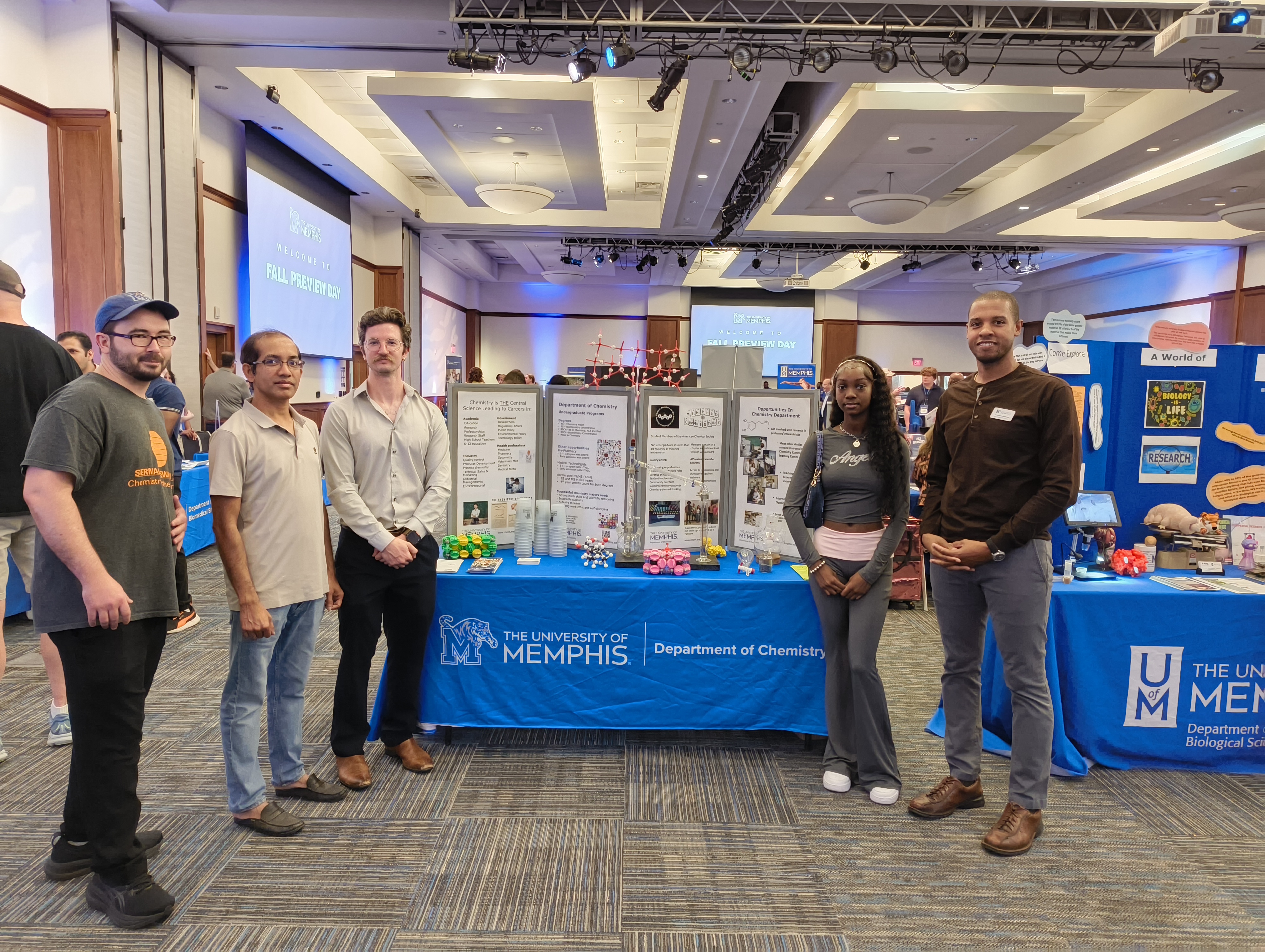
<p>For the underlying chemistry, see OpenStax <em>Chemistry 2e</em>: <a href="https://openstax.org/books/chemistry-2e/pages/12-3-rate-laws">Rate Laws</a>, <a href="https://openstax.org/books/chemistry-2e/pages/12-4-integrated-rate-laws">Integrated Rate Laws</a>, <a href="https://openstax.org/books/chemistry-2e/pages/12-5-collision-theory">Collision Theory</a>, and <a href="https://openstax.org/books/chemistry-2e/pages/12-7-catalysis">Catalysis</a>. <a href="/assets/kinetics-THIRD-PARTY-LICENSES.txt">Third-party software notices</a> accompany the bundled model.</p>]]></content><author><name>Dillon Baker</name></author><category term="Teaching &amp; outreach" /><summary type="html"><![CDATA[An interactive lab for exploring reaction order, concentration, half-life, temperature, and catalysts, with an initial-rate detective challenge.]]></summary></entry><entry><title type="html">“Can I sell you on Science?” — Fall Preview Day 2026</title><link href="https://dtabaker.github.io/2026/10/03/fall-preview-day.html" rel="alternate" type="text/html" title="“Can I sell you on Science?” — Fall Preview Day 2026" /><published>2026-10-03T17:00:00+00:00</published><updated>2026-10-03T17:00:00+00:00</updated><id>https://dtabaker.github.io/2026/10/03/fall-preview-day</id><content type="html" xml:base="https://dtabaker.github.io/2026/10/03/fall-preview-day.html"><![CDATA[<p>“Can I sell you on Science?” became my slogan while volunteering with the University of Memphis Department of Chemistry at Fall Preview Day on October 3, 2026. It was a great opportunity to meet the next generation of students, hear about their goals, and talk about where chemistry might fit into their futures.</p>

<figure class="project-figure">
  <img src="/assets/fall-preview-day-2026.jpg" alt="Five volunteers standing beside the University of Memphis Department of Chemistry table at Fall Preview Day, with molecular models and department displays." width="4080" height="3072" loading="lazy" />
  <figcaption>From left to right: Dillon Baker, Alok Das, Taylor Moore, Bailee Keys, and Dr. Johnson at Fall Preview Day on October 3, 2026.</figcaption>
</figure>

<p>Some students arrived knowing exactly what they wanted to study. Others were still exploring their options. I spoke with future engineers, nurses, teachers, and students interested in sports medicine, among others. Whatever their plans, there was a conversation to be had about the value of a chemistry education.</p>

<p>Whether as a major or a minor, chemistry offers plenty to get excited about: learning how the world works, asking questions, solving problems, and finding connections across disciplines. For me, the opportunity to do something interesting every day practically sells itself.</p>

<p>We also talked about what our department has to offer, from the research being conducted to the tutoring center and the courses available to chemistry majors and minors. I enjoyed discussing how a chemistry education could be tailored to students’ interests and goals.</p>

<p>I know it is a long shot to change someone’s life in a five- or ten-minute conversation. But I also know from personal experience that the right conversation can open a door and make chemistry feel a little less intimidating. Sometimes, helping someone feel comfortable asking their next question is a meaningful place to start.</p>

<p>I’m grateful I had the chance to be part of the day alongside Alok Das, Taylor Moore, Bailee Keys, and Dr. Johnson.</p>

<p>And next year, Dr. Johnson will need to bring more flyers. We went through every one!</p>]]></content><author><name>Dillon Baker</name></author><category term="Teaching &amp; outreach" /><summary type="html"><![CDATA[Talking with future students about their goals, the possibilities of a chemistry education, and the difference one conversation can make.]]></summary></entry><entry><title type="html">A new club and a new role: becoming TigerAI president</title><link href="https://dtabaker.github.io/2026/09/07/tigerai-president.html" rel="alternate" type="text/html" title="A new club and a new role: becoming TigerAI president" /><published>2026-09-07T18:00:00+00:00</published><updated>2026-09-07T18:00:00+00:00</updated><id>https://dtabaker.github.io/2026/09/07/tigerai-president</id><content type="html" xml:base="https://dtabaker.github.io/2026/09/07/tigerai-president.html"><![CDATA[<p>I recently joined <strong>TigerAI</strong>, a brand-new club at the University of Memphis, and the members voted me in as <strong>club president</strong>! I’m excited to help shape its direction and build a place where students from different disciplines can explore AI together.</p>

<p>Starting something new comes with a lot of possibilities. We get to ask what kind of club would be useful to students, what people want to learn, and how we can share that learning beyond our own meetings. I’m looking forward to listening to members and helping turn those ideas into something we can build together.</p>

<h2 id="making-ai-approachable">Making AI approachable</h2>

<p>My interest in AI connects with my work in computational chemistry and my interest in teaching. I enjoy exploring what these tools can help us do, but I also care about understanding how they work, checking their results, and recognizing their limitations.</p>

<p>I hope TigerAI becomes an avenue for outreach across campus and into the Memphis community. I would like to develop approachable workshops for undergraduate students and activities for local schools that introduce AI through practical examples. Students should be able to join the conversation even if they have never written code or trained a model.</p>

<p>Responsible use belongs in that conversation from the beginning. That means discussing how to evaluate an answer, protect information, and understand the expectations for a particular class or assignment. I want our activities to help people develop judgment alongside technical skills.</p>

<h2 id="connecting-with-the-universitys-ai-initiatives">Connecting with the University’s AI initiatives</h2>

<p>This feels like an exciting time to start a student AI club at Memphis. The University’s <a href="https://classic.memphis.edu/aiforall/index.php">AI for All minor</a> welcomes students from different majors and backgrounds, while its <a href="https://www.memphis.edu/herff/news/how_polytechnicuofm_is_leading_tennessees_ai_revolution.php">Applied AI initiatives</a> emphasize practical skills and preparation for an AI-influenced workforce.</p>

<p>I hope TigerAI can complement these efforts through student-led learning, discussion, and outreach. A club can give students a place to try an idea, ask questions, and connect what they are learning in their courses with problems they care about. Finding ways to align that work with the University’s broader AI initiatives is one of my goals as president.</p>

<h2 id="building-the-club-together">Building the club together</h2>

<p>TigerAI is still at the beginning, and there is plenty to figure out. For now, I’m excited about the chance to help create a welcoming community and to learn from the people who join it. I hope we can make AI feel more accessible, encourage thoughtful experimentation, and share what we learn with others.</p>

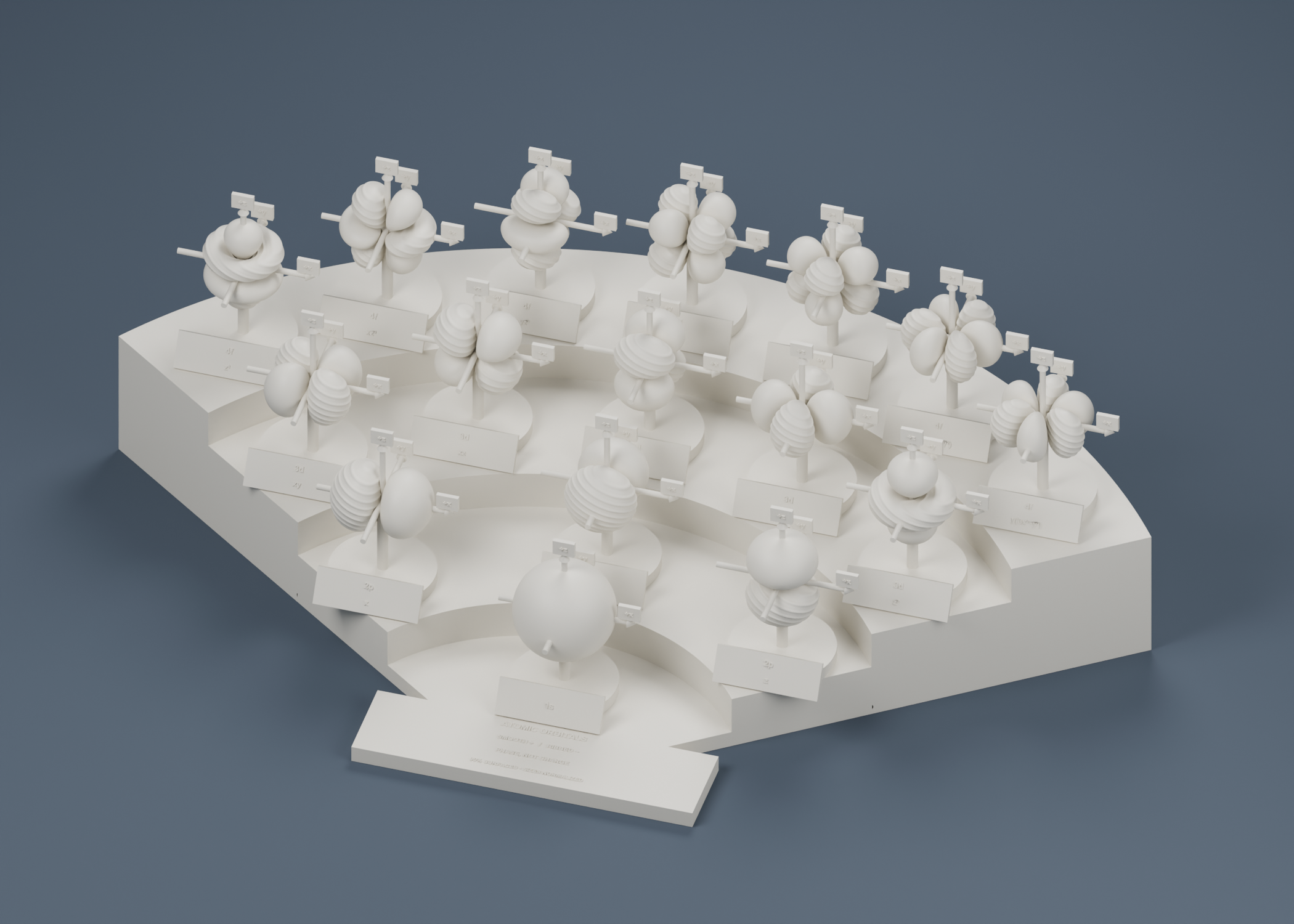
<p>If you are a University of Memphis student interested in TigerAI—or have an idea for an outreach activity—I would love to hear from you. <a href="mailto:dtbaker@memphis.edu">Send me an email</a> or <a href="https://www.linkedin.com/in/dtabaker/">connect with me on LinkedIn</a>.</p>]]></content><author><name>Dillon Baker</name></author><category term="Teaching &amp; outreach" /><category term="PhD life" /><summary type="html"><![CDATA[Joining a brand-new campus club, being elected president, and helping shape a student-led space for AI learning and outreach.]]></summary></entry><entry><title type="html">The Orbital Observatory: bringing electron orbitals into the tutoring center</title><link href="https://dtabaker.github.io/2026/09/07/orbital-observatory.html" rel="alternate" type="text/html" title="The Orbital Observatory: bringing electron orbitals into the tutoring center" /><published>2026-09-07T17:00:00+00:00</published><updated>2026-09-07T17:00:00+00:00</updated><id>https://dtabaker.github.io/2026/09/07/orbital-observatory</id><content type="html" xml:base="https://dtabaker.github.io/2026/09/07/orbital-observatory.html"><![CDATA[<p>Orbital diagrams are everywhere in chemistry, but a flat drawing can make a three-dimensional idea surprisingly difficult to see. I wanted to build something students could walk around, turn in their hands, and compare with the diagrams in their notes. That idea became the <strong>Orbital Observatory</strong>: a curved, tiered display of sixteen labeled electron orbitals.</p>

<p>I developed the design with help from AI, using mathematically generated orbital surfaces and then adapting them for 3D printing. The project brings together several things I enjoy: chemistry, coding, making things, and finding new ways to explain difficult concepts.</p>

<figure class="project-figure">
  <a href="/assets/orbital-observatory/preview.png" aria-label="View the full-size render of the printable Orbital Observatory"><img src="/assets/orbital-observatory/preview.png" alt="Render of sixteen white orbital models on four curved tiers, with labeled axes and smooth or ribbed surfaces." width="2100" height="1500" loading="lazy" /></a>
  <figcaption>A render of the printable design. The smooth and ribbed surfaces make the two wavefunction phases distinguishable in a single-color print.</figcaption>
</figure>

<h2 id="explore-the-orbitals-in-3d">Explore the orbitals in 3D</h2>

<p>To compare physical extent with one shared ruler, visit <a href="/orbital-scale/">Orbital Observatory: A Sense of Scale</a>. Its sixteen hydrogenic orbitals retain their relative sizes, and a nuclear-charge control explores one-electron H, He⁺, Li²⁺, and Be³⁺.</p>

<p>For the mathematics behind the shapes, explore <a href="/wavefunction-to-orbital/">From Wavefunction to Orbital</a>: four linked views of radial functions, angular functions, cross-sections, and probability surfaces, including all sixteen Observatory orbitals and three radial-node examples.</p>

<p>For orbital mixing and interference, explore <a href="/hybrid-orbitals/">Orbital Observatory: How Orbitals Mix</a>, with an s/p-character slider and complete sp, sp², and sp³ sets.</p>

<p>Drag to rotate the display, then use <strong>Inspect</strong> to look at one orbital at a time. You can scroll or use the zoom buttons to move closer. With the viewer focused, the arrow keys rotate and the + and − keys zoom.</p>

<div class="orbital-embed">
  <iframe src="/assets/orbitals.html" title="Interactive angular-shape model of sixteen electron orbitals" width="100%" height="740" loading="lazy" sandbox="allow-scripts" referrerpolicy="no-referrer"></iframe>
</div>
<p class="viewer-link"><a href="/assets/orbitals.html" target="_blank" rel="noopener">Open the interactive viewer in a full page ↗</a></p>

<p>This interactive model is the <strong>earlier angular-shape exploration</strong>, with equally scaled shapes and two colors for wavefunction phase. It is different from the final printable geometry shown in the render above. The viewer needs JavaScript and WebGL; the render remains available if your browser cannot display the model.</p>

<h2 id="designed-for-a-single-color-printer">Designed for a single-color printer</h2>

<p>The print set includes <strong>1s, three 2p, five 3d, and seven 4f orbitals</strong>. This gives one complete set of angular shapes for each of the s, p, d, and f subshell types; it is not every orbital through the fourth principal energy level.</p>

<p>Each orbital has its own stand, name, and consistently oriented x, y, and z axes. The modular base and keyed mounts are designed for my Elegoo Neptune 4. The assembled display is approximately 47 × 29 × 15 cm, with the individual parts printed separately.</p>

<p>Because I print in one color, the physical model uses texture instead of color: <strong>smooth surfaces indicate positive wavefunction phase, and ribbed surfaces indicate negative phase</strong>. Those signs are not electrical charges. The labels and texture are built into the geometry rather than added as paint.</p>

<p>The underlying printable surfaces come from hydrogenic wavefunctions and collectively enclose approximately 90% of each orbital’s probability. The ribs, stems, axes, and other supporting pieces are additions that make the display usable as a physical object. They are not part of the electron distribution.</p>

<h2 id="a-teaching-aid-for-the-cclc">A teaching aid for the CCLC</h2>

<p>I plan to use this display in the <a href="https://www.memphis.edu/chem/resources/cclc.php">Chemistry Community Learning Center (CCLC)</a>, where students can get help working through chemistry problems and difficult concepts. My hope is that having something physical to explore will make those conversations easier to begin.</p>

<p>Here are a few ways I would like to use it during tutoring:</p>

<ul>
  <li><strong>Connect a drawing to a shape.</strong> Start with a familiar p-orbital diagram, then rotate the corresponding module and identify what the page leaves out.</li>
  <li><strong>Compare orientation.</strong> Use the labeled axes to distinguish pₓ, pᵧ, and p_z, then compare d orbitals whose lobes point along or between axes.</li>
  <li><strong>Talk about nodes and phase.</strong> Look at the regions separated by angular nodes and use the smooth/ribbed distinction to discuss the sign of the wavefunction.</li>
  <li><strong>Build confidence with unfamiliar shapes.</strong> Compare the simpler s and p orbitals with the more intricate d and f forms without expecting students to memorize every shape at once.</li>
</ul>

<p>Just as useful are the questions about what the model leaves out. An orbital is not an electron’s path, and its displayed surface is not a hard boundary. These orbitals are scaled independently for comparison, so their sizes and positions on the tiers do not show relative atomic size or orbital energy. Supports crossing a gap do not mean electron density exists at a node.</p>

<p>The selected orbitals also have no radial nodes. Higher-energy orbitals of the same subshell type can have additional structure that this set does not show. I want those limitations to be part of the lesson: a good model helps us understand something, and understanding the model means knowing where the analogy stops.</p>

<h2 id="from-design-to-the-tutoring-table">From design to the tutoring table</h2>
<p><a href="https://github.com/DTABaker/3D-Print-Electron-Observatory">Download the STL files and printing guides on GitHub</a>
The printable set contains 25 STL designs, including the sixteen orbital modules, six base sections, a joining dowel, and two mount-fit test pieces. The accompanying teaching and assembly guides explain the geometry, phase convention, and printing setup.</p>

<p>The design has passed digital mesh checks, but a completed slice and physical print still need to be verified. I’ll start with the small fit test before printing the full display. I’m looking forward to bringing it into the CCLC and seeing which shapes—and which questions—students reach for first.</p>

<p>The mathematics behind the model is documented in the project’s teaching guide, using <a href="https://books.physics.oregonstate.edu/GMM/hydroform.html">Oregon State University’s hydrogen-atom wavefunction tables</a> and the <a href="https://openmopac.net/Manual/real_spherical_harmonics.html">real spherical harmonics reference</a>.</p>]]></content><author><name>Dillon Baker</name></author><category term="Teaching &amp; outreach" /><summary type="html"><![CDATA[A 3D-printable orbital display, an interactive exploration, and a plan for hands-on chemistry tutoring at the CCLC.]]></summary></entry><entry><title type="html">Dual Enrollment Chemistry Outreach at the University of Memphis</title><link href="https://dtabaker.github.io/2025/11/14/Dual-Enrollment-Chemistry-Outreach-Event-at-the-University-of-Memphis.html" rel="alternate" type="text/html" title="Dual Enrollment Chemistry Outreach at the University of Memphis" /><published>2025-11-14T00:00:00+00:00</published><updated>2025-11-14T00:00:00+00:00</updated><id>https://dtabaker.github.io/2025/11/14/Dual-Enrollment-Chemistry-Outreach-Event-at-the-University-of-Memphis</id><content type="html" xml:base="https://dtabaker.github.io/2025/11/14/Dual-Enrollment-Chemistry-Outreach-Event-at-the-University-of-Memphis.html"><![CDATA[<p>I had a blast volunteering again this year for the University of Memphis Chemistry Department Outreach event. This was my second year in a row getting to talk with dual enrollment high school students visiting campus, and it was really fun to share my story with them. I talked about starting out as an undergraduate at UTK before transferring here to the University of Memphis, and this year I also got to speak more about what it looks like to get ready for graduate school. It felt good to be honest about the college experience and to share a few simple tips like staying organized, asking questions, using your resources, and giving yourself time to grow into who you want to be.</p>

<p>One of my favorite parts was asking if anyone was thinking about majoring in Chemistry. Last year I opened with that question and nobody raised their hand. This year I waited until the end, and two students raised their hands, which honestly made me laugh. Maybe the demonstrations won them over this time. Overall, it was such a great experience, and I am really glad I got to be part of it again.</p>]]></content><author><name>Dillon Baker</name></author><category term="Teaching &amp; outreach" /><summary type="html"><![CDATA[Sharing the path to graduate school with the next generation of chemistry students.]]></summary></entry><entry><title type="html">Notes from SERMACS: First Talk, Fresh Ideas, and a Stronger Community</title><link href="https://dtabaker.github.io/2025/10/27/SERMACS.html" rel="alternate" type="text/html" title="Notes from SERMACS: First Talk, Fresh Ideas, and a Stronger Community" /><published>2025-10-27T00:00:00+00:00</published><updated>2025-10-27T00:00:00+00:00</updated><id>https://dtabaker.github.io/2025/10/27/SERMACS</id><content type="html" xml:base="https://dtabaker.github.io/2025/10/27/SERMACS.html"><![CDATA[<p>I came back from SERMACS energized and grateful—for the science, the mentorship, and the people who make both possible. The meeting was a whirlwind in the best way, and I left with a notebook full of ideas and a clearer sense of where my work fits in the broader chemical enterprise.</p>

<h3 id="my-first-conference-oral-presentation">My first conference oral presentation</h3>
<p><img src="https://github.com/user-attachments/assets/22442e79-1be0-4e45-ac6b-b35a1d51ecd7" alt="First-Oral-Presentation-Photo" /></p>
<p>Giving my first talk was both nerve‑wracking and thrilling. Once I got going, the room’s energy turned those nerves into momentum. The turn out for the Polymer session was greater than expected: I was told to expect ~5-10 people; the actual number was closer to 30! The Q&amp;A felt like a mini‑mentorship session: thoughtful questions, specific suggestions, and encouragement that sharpened my next steps. I left with actionable feedback I can use immediately—how to frame the project to greater the impact for experimentalists. I’m genuinely proud of that milestone and grateful for the support behind it.</p>

<p><br /></p>

<h3 id="the-chemical-patent-workshop">The Chemical Patent Workshop</h3>
<p>The session demystified how ideas travel from lab bench to protected intellectual property. We walked through the lifecycle of an invention, from documenting novelty to understanding prior art and thinking strategically about claims. I appreciated the practical advice—how to partner with tech transfer, what to consider before submitting a manuscript, and how to frame our work so its real-world impact is clear. It shifted how I’ll plan experiments and communicate results. I never knew the career opportunities for chemists as patent agents. Anyone with a Bachelors degree can sit for the Patent Bar exam - I wonder if I completed my Patent Agent license if the University will let me GA for the Research and Innovation department.</p>

<p><br /></p>

<h3 id="people-make-the-meeting">People make the meeting</h3>
<p>The best part of SERMACS was the community. I met new colleagues whose perspectives will shape how I think and work, and already‑established friendships grew closer over coffee, poster aisles, and long hallway chats.</p>

<p><img src="https://github.com/user-attachments/assets/fda5997e-c234-44a8-9466-30ff0a0a15a6" alt="IMG_5016" />
Special shoutouts to David Basnet and Tolulope Alaye from Dr. Alexander’s group. It was great to have friends to rely on throughout the trip.</p>

<p><br /></p>

<h3 id="too-much-great-science-to-list">Too much great science to list</h3>
<p>There were too many great presentations to mention, but it was great to see a wide range of research with both academic and industry presentations. That blend—fundamental discovery alongside scale‑up, sustainability, and translational challenges—made the program feel especially relevant. It’s motivating to see how the questions we ask in the lab map onto the problems companies and communities are trying to solve right now.</p>

<p><br /></p>

<h3 id="what-comes-next">What comes next</h3>
<p>I’m organizing my notes, reaching out to new contacts, and integrating the feedback from my talk into the next iteration of my work. I’m also lining up internship applications and sketching a plan to apply what I learned from the patent workshop to our current projects. SERMACS delivered exactly what I hoped for: fresh science, practical skills, and a stronger network. I’m thankful to the organizers, speakers, and everyone who made time to connect—see you at the next meeting.</p>

<p><img src="https://github.com/user-attachments/assets/d863d07e-5588-4527-be80-e511830763a6" alt="SERMACS-Group-Photo" />
Group Photo of University of Memphis Graduate Students at SERMACS   — Photo taken by my wife, Michaela Baker.</p>]]></content><author><name>Dillon Baker</name></author><category term="Research" /><summary type="html"><![CDATA[A polymer session, a room full of fresh ideas, and the community that makes science worth sharing.]]></summary></entry></feed>